Laurence Sterne (24 November 1713 – 18 March 1768) was an Irish-born English language novelist and an Anglican clergyman. He wrote the novels The Life and Opinions of Tristram Shandy, Gentleman and A Sentimental Journey Through France and Italy, and also published many sermons, wrote memoirs, and was involved in local politics. Sterne died in London after years of fighting tuberculosis.
Charles Bruce Chatwin (13 May 1940 – 18 January 1989) was an English novelist and travel writer. He won the James Tait Black Memorial Prize for his novel On the Black Hill (1982). Married and bisexual, he was one of the first prominent men in Britain known to have contracted HIV and died of AIDS, although he hid the facts of his illness.
William Thomas Gaddis, Jr. (December 29, 1922 – December 16, 1998) was an American novelist.[1][2] The first and longest of his five novels, The Recognitions, was named one of TIME magazine's 100 best novels from 1923 to 2005[3] and two others won the annual U.S. National Book Award for Fiction.[4] A collection of his essays was published posthumously as The Rush for Second Place (2002). The Letters of William Gaddis was published by Dalkey Archive Press in February 2013.
Laurence Sterne (24 November 1713 – 18 March 1768) was an Anglo-Irish novelist and an Anglican clergyman. He is best known for his novels The Life and Opinions of Tristram Shandy, Gentleman, and A Sentimental Journey Through France and Italy; but he also published many sermons, wrote memoirs, and was involved in local politics. Sterne died in London after years of fighting consumption.
Clive Staples Lewis (29 November 1898 – 22 November 1963), commonly called C. S. Lewis and known to his friends and family as "Jack", was a novelist, poet, academic, medievalist, literary critic, essayist, lay theologian, and Christian apologist. Born in Belfast, Ireland, he held academic positions at both Oxford University (Magdalen College), 1925–1954, and Cambridge University (Magdalene College), 1954–1963. He is best known both for his fictional work, especially The Screwtape Letters, The Chronicles of Narnia, and The Space Trilogy, and for his non-fiction Christian apologetics, such as Mere Christianity, Miracles, and The Problem of Pain.
Thomas Clayton Wolfe (October 3, 1900 – September 15, 1938) was a major American novelist of the early 20th century. Wolfe wrote four lengthy novels, plus many short stories, dramatic works and novellas. He is known for mixing highly original, poetic, rhapsodic, and impressionistic prose with autobiographical writing. His books, written and published from the 1920s to the 1940s, vividly reflect on American culture and mores of the period, albeit filtered through Wolfe's sensitive, sophisticated and hyper-analytical perspective. He became very famous during his own lifetime.
After Wolfe's death, his chief contemporary William Faulkner said that Wolfe may have had the best talent of their generation. Wolfe's influence extends to the writings of famous Beat writer Jack Kerouac, authors Ray Bradbury and Philip Roth, among others. He remains one of the most important writers in modern American literature, as he was one of the first masters of autobiographical fiction. He is considered North Carolina's most famous writer.
Wikipedia
Photograph from Wikipedia (Library of Congress)
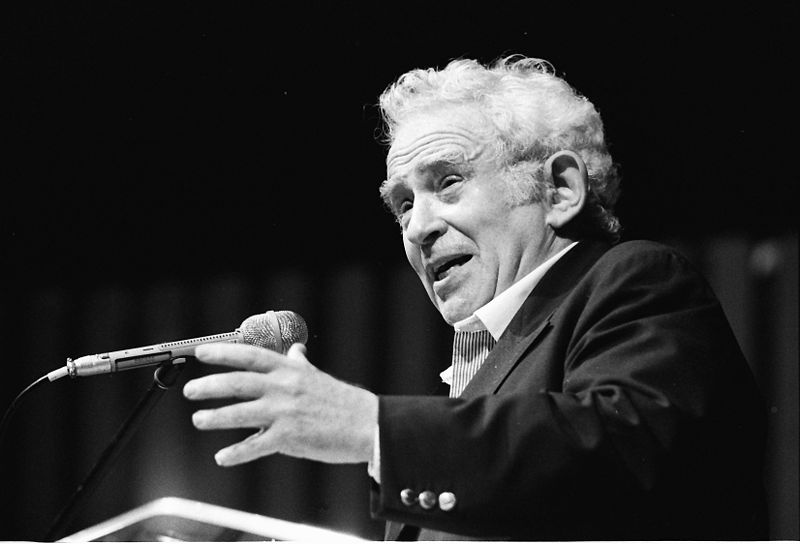
Norman Kingsley Mailer (January 31, 1923 – November 10, 2007) was an American novelist, journalist, essayist, playwright, film maker, actor and political candidate. His first novel was The Naked and the Dead published in 1948. His best work was widely considered to be The Executioner's Song, which was published in 1979, and for which he won one of his two Pulitzer Prizes. In addition to the Pulitzer Prize, Mailer's book Armies of the Night was awarded the National Book Award.
Along with the likes of Truman Capote, Hunter S. Thompson and Tom Wolfe, Mailer is considered an innovator of creative nonfiction, a genre sometimes called New Journalism, which superimposes the style and devices of literary fiction onto fact-based journalism.
In 1955, Mailer and three others founded The Village Voice, an arts and politics oriented weekly newspaper distributed in Greenwich Village.
William Thomas Gaddis, Jr., December 29, 1922 – December 16, 1998, was an American novelist. The first and longest of his five novels, The Recognitions, was named one of TIME magazine's 100 best novels from 1923 to 2005 and two others won the annual U.S. National Book Award for Fiction. A collection of his essays was published posthumously as The Rush for Second Place (2002).
Eugene Luther Gore Vidal, October 3, 1925 – July 31, 2012, was an American author, playwright, essayist, screenwriter, and political activist. His third novel, The City and the Pillar (1948), outraged mainstream critics as one of the first major American novels to feature unambiguous homosexuality. He also ran for political office twice and was a longtime political critic.
Gore Vidal dies aged 86
Feisty American author wrote widely on everything from politics and literature to homosexuality and religion The Guardian, 1.8.2012
US author Gore Vidal dies aged 86
Celebrated writer and political commentator Gore Vidal has died aged 86, his family has confirmed. BBC, 1.8.2012
With some telling comments by readers.
If one listens closely to the words of Gore Vidal, one wonders how he could hve been popular. There is a contradiciton, not on his side, but on the side of the American public. Obviously popularity doesn't ncessarily come along with understanding. Ohterwise American politics would be quite different. But his is, of course, not to count on Gore Vidal who was outspoken and highly educated. The Americans generally are of low education, as Vidal for himself compared often in contrast to the Europeans. Unfortunately, this low educated not knowing people easyly can be fooled and welcome to be fooled. This is an eminent danger, not the last, of which Gore Vidal spoke often.
Addendum:
'The Man Who Knew Everyone' - Gore Vidal Through The Eyes Of The One Per Cent Press David Edwards, MEDIA LENS, August 20, 2012
Christina Stead (17 July 1902 – 31 March 1983) was an Australian novelist and short-story writer acclaimed for her satirical wit and penetrating psychological characterisations. She was born in Rockdale, New South Wales, and died in Sydney. Her novel "The Man Who Loved Children", written 1940, has become known only after a reissue edition in 1965, introduced by Randall Jarrell.
The modern world was created by those who haunted the Austrian capital in the first 14 years of the 20th century. The writer returns to the place that gave rise to his latest novel, Waiting for Sunrise William Boyd, Guardian, Friday 3 February 2012

 Laurence Sterne (24 November 1713 – 18 March 1768) was an Irish-born English language novelist and an Anglican clergyman. He wrote the novels The Life and Opinions of Tristram Shandy, Gentleman and A Sentimental Journey Through France and Italy, and also published many sermons, wrote memoirs, and was involved in local politics. Sterne died in London after years of fighting tuberculosis.