The two latest issues of the LONDON REVIEW OF BOOKS are available n our library:
 Vol. 37 No. 3 · 5 February 2015:
Here a short letter concerning "Charlie Hebdo" and the answer by the chief editor of the LRB:
On ‘Charlie Hebdo’
As a devoted reader of the LRB I am deeply disappointed by your immediate response to the Charlie Hebdo
attack. No message of solidarity, no support for freedom of expression.
I would have thought that the execution of the editorial staff of a
magazine a few hours’ journey from your own office would provoke a more
heartfelt response.
Simon Hammond
London E1
Mary-Kay Wilmers writes: I
believe in the right not to be killed for something I say, but I don’t
believe I have a right to insult whomever I please. Those – and there
are many – who insist that the only acceptable response to the events in
Paris is to stand up for ‘freedom of expression’ are allowing people
the freedom to say ‘Je suis Charlie’ but nothing else. There are many
other things to be said about the attacks and their aftermath: for some
of them, see Tariq Ali in this issue, and the contributions online at
www.lrb.co.uk/charliehebdo.
Typical for the LRB's cowardice (and shared by a large part of the British public) is this articles:
The Brits qualify the fundamental right of free press and free expression and are allk too willing to limit according avoidance of hurting someones feelings. But there can't be any freedom without it's reverse (nothing has only one side...)
Very interesting this historical review:
-
-
The Deluge: The Great War and the Remaking of Global Order by Adam Tooze
On ‘Charlie Hebdo’
Tariq Ali asks: ‘Why was Catholicism never blamed for the IRA offensives?’ (
LRB, 5 February).
The simple answer is that IRA killings were not done in the name of the
Church; as far as we know, bombs were not thrown with a cry of ‘This is
for Mary, Mother of God.’ Ali is confusing the categories of creed and
community.
Birkbeck, University of London
Tariq Ali quotes the ‘waspish’ Eric Hazan, who
claims that the recent million-strong Paris demonstration was ‘as big’
as the demonstration on 28 April 1944, when Pétain visited Paris to
commemorate the victims of a recent Allied bombing raid. Inspection of
photos and newsreel taken on the day of Pétain’s visit, coupled with
diary accounts, show clearly that around 15,000 people attended – the
vast majority invited by the regime. The ludicrous figure of a million
was proclaimed in Vichy newsreels by the fascist Marcel Déat and has no
basis in reality. The true comparison is with the chaotic celebration of
the Liberation of Paris on 26 August 1944, which numbered well over a
million participants.
Matthew Cobb
University of Manchester
-
-
Quite a Good Time to Be Born: A Memoir, 1935-75 by David Lodge
-
Lives in Writing: Essays by David Lodge
-
-
The Letters of Robert Frost, Vol. 1: 1886-1920 edited by Donald Sheehy, Mark Richardson and Robert Faggen




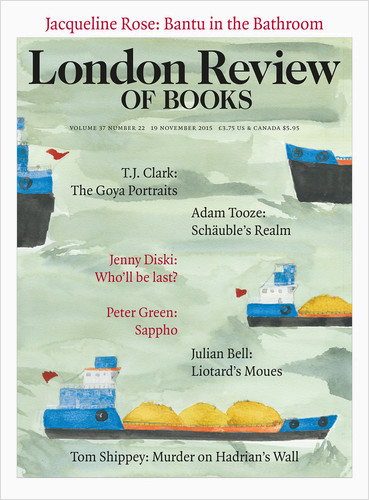 The newest issue of the LONDON REVIEW OF BOOKS, Vol. 37 No. 22 · 19 November 2015, has appeared; it is available in our library!
 The newest issue Vol. 37(2015)20,


 The second issues of 2015 of THE NEW YORK REVIEW OF BOOKS as well as LONDON REVIEW OF BOOKS have arrived and are available at our library:


